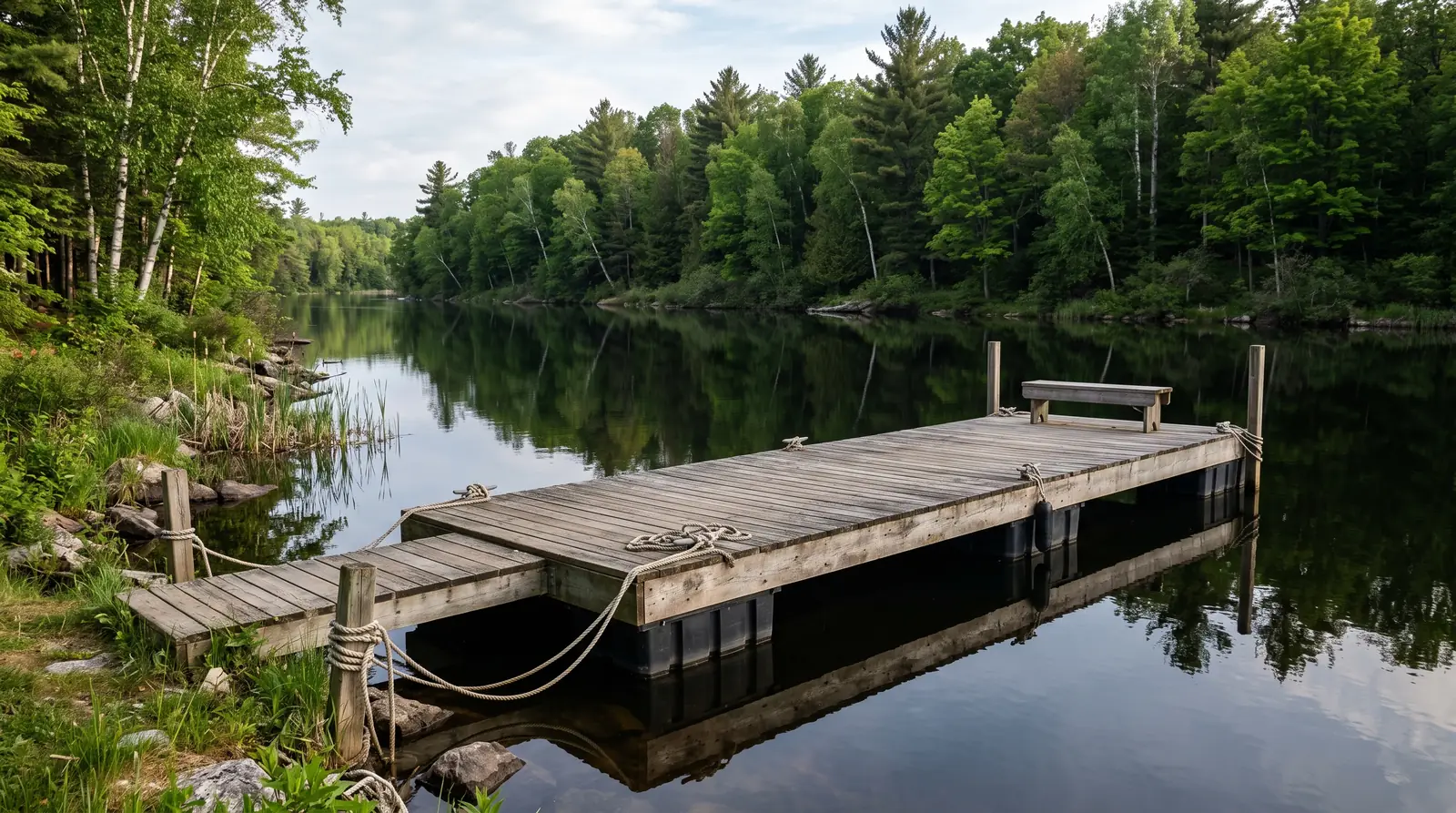
Once the dock is out for the season, the boards are easy to look at closely. Soft spots, split ends, popped screws and splinters all show up when the sections are stacked on shore. If the decking is near the end of its life, winter is the right time to decide what goes on next, so the work can be booked well before spring installation.
This guide compares the three common decking choices for docks around Collingwood, The Blue Mountains and Wasaga Beach: wood, composite and aluminum.
Is it the decking or the frame?
Before choosing a new surface, find out what is actually worn out. Decking is the part you walk on. The frame, stringers, pipes, floats and brackets underneath carry the load.
Signs that the decking alone needs work:
- Boards that flex or feel soft underfoot, but a frame that is straight and solid
- Splits, checking and splinters on the surface
- Screws or nails backing out because the wood has shrunk and swelled for years
- Grey, worn boards that are still structurally fine but rough on bare feet
Signs the problem goes deeper:
- Sagging between supports, even with new boards
- Rot or rust at joints, brackets or where the frame meets the pipes
- Floats that sit low or unevenly
- Sections that no longer line up when installed
If the frame is sound, new decking can make an old dock feel new for a fraction of a rebuild. If it isn’t, putting expensive boards on a tired frame is money in the wrong place. A dock repair inspection while the sections are on land answers this quickly.
Option 1: Wood decking
Pressure-treated lumber is still the most common decking on Georgian Bay docks. Cedar is a popular upgrade for owners who want a natural look.
Why people choose it
- Lowest upfront cost of the three options
- Easy to cut, fit and repair, so a broken board is a quick fix
- Familiar look that suits older cottages and natural shorelines
- Most installers and handy owners can work with it
The downsides
- Needs regular care: cleaning, and staining or sealing every few years if you want it to last
- Splinters, checking and warping over time, especially in full sun
- Boards can get slippery when algae builds up in shaded or wet spots
- Shorter life than the other two options, so you will redo it sooner
Wood still makes sense for a seasonal dock you plan to replace within a decade, a budget-sensitive project, or a cottage where the look matters more than low maintenance.
Option 2: Composite decking
Composite boards are made from a mix of wood fibre and plastic, or are fully plastic (often called PVC decking). They have become common on newer docks around Collingwood and Blue Mountains.
Why people choose it
- Very little maintenance: no staining or sealing, just an occasional wash
- No splinters, which matters for kids, dogs and swimmers
- Holds its colour and shape much better than wood
- Long service life when installed to the maker’s specs
The downsides
- Higher upfront cost than wood
- Heavier, which matters on floating sections and anything you lift in and out each year
- Darker colours can get hot in full summer sun
- Needs closer support spacing than wood on many products, so it may not suit every existing frame
- Some products are not rated for constant water contact or direct ground contact, so check the manufacturer’s guidance for dock use
That last point is the one people miss. Composite that is fine on a backyard deck may not be the right product for a dock that sits inches above Nottawasaga Bay. Ask for a board that is specifically approved for docks or marine use.
Option 3: Aluminum decking
Aluminum decking usually comes as interlocking planks or panels on an aluminum frame. Some docks use grated or perforated panels that let light and water pass through.
Why people choose it
- Lightest of the three, which makes fall removal and spring installation easier
- Will not rot, warp or splinter
- Very little upkeep
- Grated panels let waves wash through and let light reach the water below
The downsides
- Usually the highest upfront cost
- A more industrial look that some owners don’t love at a traditional cottage
- Solid aluminum can get hot in direct sun, though lighter finishes and grated panels help
- Best paired with an aluminum frame; mixing metals and wood frames needs the right hardware
Aluminum is a strong choice for removable docks that come in and out every year, for owners who are getting older and want lighter sections, and for shallow, wavy shorelines where water needs to drain off fast.
Side by side
| Wood | Composite | Aluminum | |
|---|---|---|---|
| Upfront cost | Lowest | Middle to high | Highest |
| Maintenance | Regular staining or sealing | Occasional wash | Occasional wash |
| Weight | Moderate | Heaviest | Lightest |
| Splinters | Yes, over time | No | No |
| Heat in full sun | Stays fairly cool | Can get hot (dark colours) | Can get hot (solid panels) |
| Lifespan | Shortest | Long | Long |
| Easy board repair | Yes | Moderate | Moderate |
What matters most on southern Georgian Bay
Removal every fall
Most docks in Collingwood, Wasaga Beach and Blue Mountains come out every fall to avoid ice damage. That means every board you add gets carried twice a year. If your sections are already heavy, composite can push them past what two people can comfortably handle. Aluminum often makes dock removal and reinstallation faster and safer.
Sun and exposure
Many docks around Collingwood and Thornbury face open water with little shade. Lighter colours and grated panels stay cooler on exposed docks.
Waves and spray
Exposed shorelines take a lot of wave action in fall storms. Decking that sheds water quickly and fastens down securely holds up better. Grated aluminum panels are a good fit where waves regularly wash over the dock.
Floating sections
On a floating dock, weight affects how high the dock sits in the water. Heavier decking can lower the freeboard, so check the float capacity before switching to composite. If you are thinking about converting from pipe to floating or adding sections, it is worth reviewing the whole setup as a dock upgrade rather than just the boards.
Timing: why winter is the best time to decide
Spring is the busiest time for docks on Georgian Bay. If you wait until the ice is out to plan new decking, you are competing with everyone who needs a dock put back in. Deciding over the winter lets the work be scheduled, materials ordered and the sections finished in time for dock installation in late April or May.
If you are in Collingwood, The Blue Mountains or Wasaga Beach, take a few photos of your sections now, note the worst spots, and measure the total length and width. That makes it much easier to get accurate quotes.
Quick answers
What is the most low-maintenance dock decking?
Composite and aluminum both need very little upkeep: no staining or sealing, just an occasional wash. Aluminum is lighter, which helps if your dock comes out every fall. Composite has a more traditional look but adds weight.
Can I put composite decking on my old wood dock frame?
Sometimes. Many composite boards need closer support spacing than wood, so an older frame may need extra joists. The frame also has to be in good enough shape to last as long as the new boards. Have it checked while the sections are out of the water.
When should I replace dock decking on Georgian Bay?
Winter is the best time to plan it. The dock is already out of the water, and booking the work before spring means it can be done in time for installation once the ice is gone.
 Waterfront upgrades
 Dock repair
 Spring dock installation